 SlidesClock
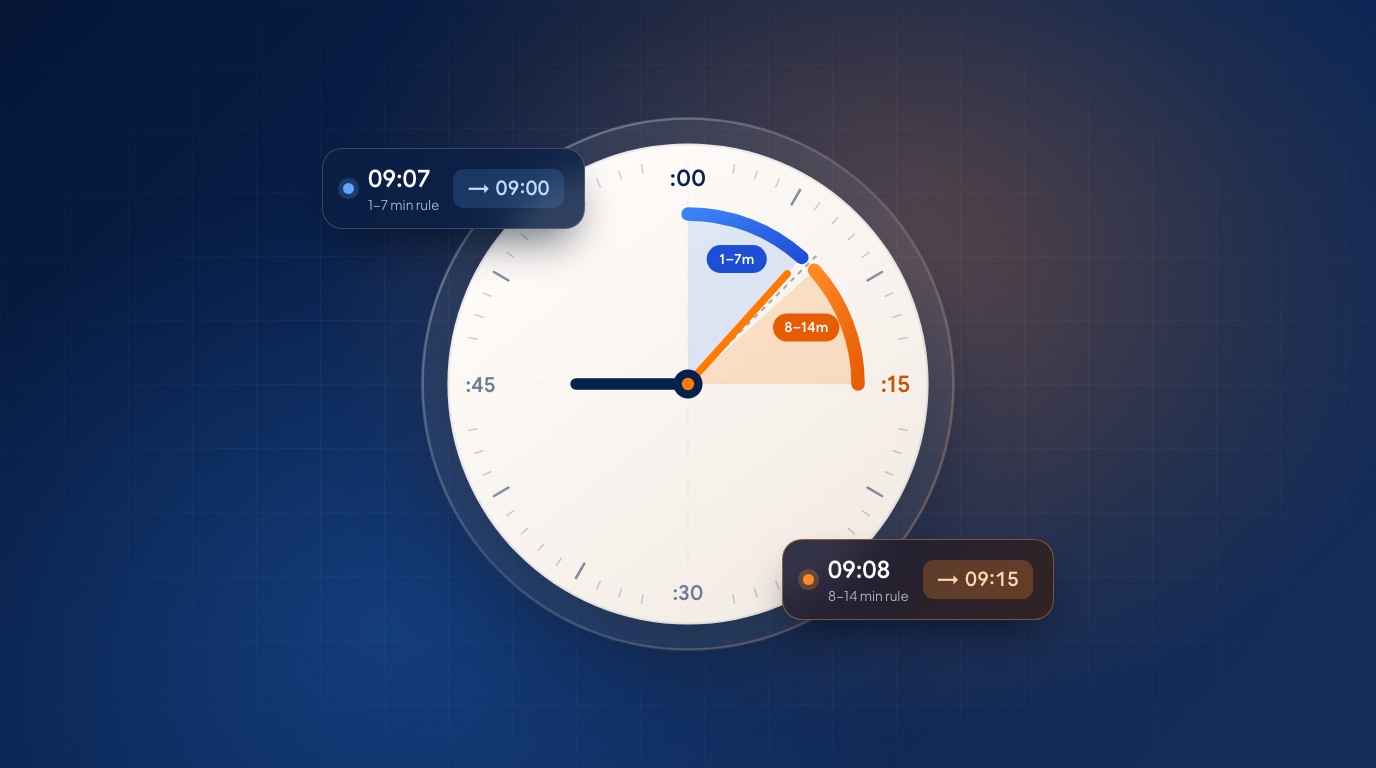

Rounding employee punches to the nearest quarter hour started decades ago to make paper timecards easier to add up before payroll. Today, many small businesses still use the 7-minute rule without realizing how quickly a sloppy rounding setup creates unpaid minutes, payroll disputes, or compliance risk. This guide explains how time clock rounding works, gives you a complete 15-minute rounding chart, compares 5-minute, 6-minute and 15-minute increments, walks through the legal boundaries, and includes a policy template you can copy — plus an honest look at when exact-minute tracking is simpler than rounding at all.
Quick Answer
Time clock rounding adjusts an employee's exact clock-in and clock-out times to the nearest set increment, usually 5, 6, or 15 minutes. Under the 7-minute rule for 15-minute rounding, punches from 1 to 7 minutes past a quarter hour round down to the previous quarter hour, and punches from 8 to 14 minutes round up to the next quarter hour. Under U.S. federal rules (29 CFR 785.48), rounding is only permitted if it is neutral and does not systematically underpay workers over time.
What is time clock rounding, and what is the 7-minute rule?
Time clock rounding is the practice of adjusting an employee's recorded start or end time to the nearest predetermined increment — most commonly 5 minutes, 6 minutes (one-tenth of an hour), or 15 minutes (one-quarter of an hour) — before calculating paid hours.
The 7-minute rule is the standard midpoint rule for 15-minute rounding. Because a 15-minute interval has 14 minutes between quarter-hour marks, the midpoint sits right between minute 7 and minute 8:
- 1 to 7 minutes past a quarter hour rounds back (down) to the prior quarter hour. For example, 09:07 rounds to 09:00, and 17:06 rounds to 17:00.
- 8 to 14 minutes past a quarter hour rounds forward (up) to the next quarter hour. For example, 09:08 rounds to 09:15, and 17:09 rounds to 17:15.
- Exact quarter hours (:00, :15, :30, :45) stay unchanged.
Why the 7-minute rule works symmetrically
Notice that 1–7 is seven possible minutes and 8–14 is also seven possible minutes. Neither side is wider than the other. That symmetry is why the 7-minute rule is considered facially neutral: an employee who clocks in at 09:04 gets credited from 09:00 (+4 minutes in their favor), while an employee who clocks in at 09:08 gets credited from 09:15 (-7 minutes). Over many shifts, the small gains and losses are supposed to balance out.
15-minute time clock rounding chart (7-minute rule)
Use this reference chart when checking quarter-hour punches and converting them into decimal hours for payroll. If you convert exact minutes into decimals instead, see our guide on how to calculate employee hours for payroll.
| Actual punch minutes | Direction | Rounded time | Decimal hour |
|---|---|---|---|
| :00 to :07 | Round back | :00 | 0.00 |
| :08 to :15 | Round forward | :15 | 0.25 |
| :16 to :22 | Round back | :15 | 0.25 |
| :23 to :30 | Round forward | :30 | 0.50 |
| :31 to :37 | Round back | :30 | 0.50 |
| :38 to :45 | Round forward | :45 | 0.75 |
| :46 to :52 | Round back | :45 | 0.75 |
| :53 to :59 | Round forward | :00 (next hour) | 1.00 |
Comparing 5-minute, 6-minute, and 15-minute rounding
Quarter-hour rounding is the widest increment generally discussed under U.S. federal guidance, not the only option. Smaller increments reduce the gap between actual and paid minutes on every single shift.
| Method | Midpoint split | Payroll decimals | Maximum shift variance per punch | Best fit |
|---|---|---|---|---|
| Exact minutes (no rounding) | None | Minutes divided by 60 (for example, 7h 42m = 7.70) | 0 minutes | Most teams using digital attendance apps or modern payroll software |
| 5-minute rounding | 1–2 min down; 3–4 min up | Multiples of 0.0833 hr | Up to 2 minutes | Teams wanting tidy shift logs with minimal pay drift |
| 6-minute rounding (tenth of an hour) | 1–3 min down; 4–5 min up | Clean tenths: 0.1, 0.2, 0.3 ... 1.0 | Up to 3 minutes | Billing or payroll spreadsheets formatted in tenths of an hour |
| 15-minute rounding (7-minute rule) | 1–7 min down; 8–14 min up | Quarters: 0.00, 0.25, 0.50, 0.75 | Up to 7 minutes | Legacy paper or punch-card workflows where smaller math is impractical |
Worked example: exact minutes vs. neutral rounding vs. one-sided rounding
The clearest way to see why neutrality matters is to run one full workweek through all three calculations. Assume an employee is scheduled from 09:00 to 17:00 (paid straight 8-hour shifts, Monday through Friday) and punches in and out at realistic, slightly varied times each day.
| Day | Actual punches | Exact time worked | Neutral 7-min rule | One-sided (employer-favoring) |
|---|---|---|---|---|
| Monday | 08:56 – 17:05 | 8h 09m (8.15 hrs) | 09:00 – 17:00 = 8.00 hrs (-9m) | 09:00 – 17:00 = 8.00 hrs |
| Tuesday | 09:04 – 17:09 | 8h 05m (8.08 hrs) | 09:00 – 17:15 = 8.25 hrs (+10m) | 09:15 – 17:00 = 7.75 hrs |
| Wednesday | 08:51 – 16:56 | 8h 05m (8.08 hrs) | 08:45 – 17:00 = 8.25 hrs (+10m) | 09:00 – 16:45 = 7.75 hrs |
| Thursday | 09:08 – 17:06 | 7h 58m (7.97 hrs) | 09:15 – 17:00 = 7.75 hrs (-13m) | 09:15 – 17:00 = 7.75 hrs |
| Friday | 08:57 – 16:55 | 7h 58m (7.97 hrs) | 09:00 – 17:00 = 8.00 hrs (+2m) | 09:00 – 16:45 = 7.75 hrs |
| Weekly total | 5 shifts | 40h 15m (40.25 hrs) | 40h 15m (40.25 hrs · net 0m) | 39h 00m (39.00 hrs · -75m unpaid) |
What the numbers reveal
Under neutral rounding, small daily swings (-9, +10, +10, -13, +2 minutes) cancel out to 40.25 paid hours, matching exact minutes and preserving the 15 minutes of weekly overtime. Under one-sided rounding — where an employer rounds late arrivals forward and early departures backward, or always rounds against the employee — the worker loses 1 hour and 15 minutes of earned pay in a single week and loses overtime altogether. That pattern is illegal under federal law and quickly triggers wage claims when multiplied across a team.
Are time clock rounding rules legal?
Time clock rounding sits under strict wage-and-hour scrutiny, and the rules depend heavily on where your business operates.
In the United States, federal regulation 29 CFR § 785.48 allows employers to round recording times to the nearest 5 minutes, one-tenth of an hour, or quarter of an hour, provided the arrangement averages out so employees are fully paid for all time actually worked. The U.S. Department of Labor Fact Sheet #53 explicitly illustrates the 1–7 minute / 8–14 minute split and stresses that employers cannot always round down. Employers also remain responsible for accurate timekeeping records under Fact Sheet #21 on FLSA recordkeeping.
State law can be far stricter than federal law. In California, the state Supreme Court ruled in Donohue v. AMN Services (2021) that employers cannot round meal-period punches at all, because even a 1-minute shortfall on a required 30-minute meal break matters under state break rules. California appellate courts (including Camp v. Home Depot, under California Supreme Court review) have also questioned whether general shift rounding can ever be justified when an electronic time clock already captures exact minutes.
Outside the United States, labour laws in the EU, UK, and across Asia generally focus on accurate, objective records of actual daily working time rather than quarter-hour approximations. This guide is general information, not legal advice — check your local wage rules or consult an employment adviser before adopting any rounding policy, and review our broader guide to employee time tracking laws.
- Never round only in the company's favor (for example, rounding clock-ins up and clock-outs down).
- Never round meal breaks or statutory rest breaks. Always record exact break start and end times; see how to track employee break times.
- Watch how rounding interacts with overtime thresholds. Rounding that repeatedly trims minutes right above 40 hours per week creates immediate overtime exposure; see how to track employee overtime.
- Keep the original, unrounded timestamps. If an audit or dispute happens, you need both the raw server punch and the payroll calculation.
Time clock rounding vs. grace periods: do not mix them up
Small business owners often say they want 'a 10-minute rounding rule' when what they actually want is a 10-minute grace period for lateness. Those are two completely different tools, and confusing them causes unfair pay and messy attendance reports.
- A grace period affects attendance status, not pay. If a shift starts at 09:00 with a 5-minute grace period and an employee arrives at 09:04, they are marked on time rather than late — while payroll still pays their exact worked minutes.
- Time clock rounding changes the timestamp used for pay. Even with a neutral rule, rounding modifies paid minutes on every shift and requires ongoing neutrality audits.
- The hidden trap: combining a strict attendance policy ('never punch in early, never leave late, 1 minute late is a write-up') with 15-minute rounding breaks neutrality in practice. Employees bunch their punches at 08:55–08:59 (rounded to 09:00) and 17:01–17:05 (rounded to 17:00), quietly donating 5 to 10 unpaid minutes every shift.
How to audit whether your rounding policy is actually neutral
A rounding rule can look symmetrical on paper and still underpay employees in real life because of shift-change queues, opening routines, or store closing tasks. Run a quick neutrality audit once a quarter:
- Export both exact timestamps and rounded hours for a full 90-day period.
- Compare total exact minutes worked against total rounded minutes paid for the whole team and for each individual employee.
- Flag any employee or department where rounded hours consistently fall below exact hours. Even a small average loss per shift adds up across a year.
- Check for policy friction: if staff routinely clock in 3–6 minutes early to avoid a late mark and clock out 3–6 minutes late to finish closing, switch to exact-minute pay instead of trying to tweak the rounding window.
Free time clock rounding policy template
If your business genuinely needs a rounding rule and local law permits it, write the rules clearly in your handbook alongside your employee attendance policy template and missed punch policy. Have a local legal or payroll adviser review it before rolling it out.
TIME CLOCK ROUNDING POLICY
[Company name] | Effective date: [date] | Applies to: [non-exempt / hourly employees]

1. PURPOSE
This policy explains how [Company name] records work time and applies neutral time clock rounding where permitted by law, so every employee is paid accurately for all hours worked.

2. RECORDING ACTUAL TIME
- Employees must clock in when they begin work and clock out when they finish work.
- Do not perform off-the-clock work before clocking in or after clocking out.
- Original, unrounded clock-in and clock-out timestamps are always retained in the attendance record.

3. NEUTRAL ROUNDING RULE (15-MINUTE / 7-MINUTE RULE)
- Shift start and end punches are rounded to the nearest 15-minute increment using a strictly neutral midpoint:
  * Minutes :01–:07 round back to :00; :08–:14 round forward to :15
  * Minutes :16–:22 round back to :15; :23–:30 round forward to :30
  * Minutes :31–:37 round back to :30; :38–:45 round forward to :45
  * Minutes :46–:52 round back to :45; :53–:59 round forward to :00 of the next hour
- Rounding is applied identically to clock-ins and clock-outs and is never weighted against the employee.

4. MEAL AND REST BREAKS (NO ROUNDING)
- Unpaid meal breaks are never rounded. Employees must record exact break start and end times and take the full uninterrupted break required by company schedule and local law.

5. GRACE PERIODS AND ATTENDANCE
- Rounding affects payroll calculation only; schedule expectations and lateness grace periods are governed separately by the company attendance policy.
- Employees may not deliberately delay clocking out or clock in early to manipulate rounded increments.

6. QUARTERLY NEUTRALITY REVIEW
- Management reviews raw timestamps against rounded totals every [quarter] to verify that the policy remains neutral in practice and does not systematically underpay any employee or group.

7. CORRECTIONS AND QUESTIONS
- Report any missed punch or pay discrepancy within [24 hours] or before payroll closes using our correction procedure.

EMPLOYEE ACKNOWLEDGMENT
I have read and understood this Time Clock Rounding Policy.
Name: ____________  Signature: ____________  Date: ____________
Why most small teams skip rounding altogether (and how SlidesClock helps)
Rounding existed to save payroll clerks from adding up odd minutes by hand on paper cards. Once attendance is recorded digitally on employees' phones, adding exact minutes takes no extra effort — and skipping rounding removes neutrality audits, employee distrust over 'lost' minutes, and state-by-state rounding restrictions.
SlidesClock is designed around exact, transparent records rather than hidden adjustments:
- Exact server timestamps: employees Slide In and Slide Out on their own phone, and the server records the exact time — independent of the phone's local clock settings.
- Configurable shift grace periods: set per-weekday schedules and grace periods for lateness and early leaving in work schedules, so arriving 3 minutes after 09:00 does not trigger a false late flag while hours remain accurate.
- Point-in-time verification: verify punches per workplace using GPS accuracy-aware geofencing, workplace Wi-Fi, or a registered device — with no background location tracking.
- Transparent correction history: when a punch is missed or wrong, corrections are stored beside the original record rather than quietly overwriting it.
- Clean exports for payroll: review exact hours by workplace and period and export structured CSV or PDF files from the Standard plan ($12.99/month for up to 20 employees and 3 locations), or turn on optional internal payroll tools and attendance corrections on Premium ($29.99/month for up to 40 employees and 10 locations).
Start with exact records for free
If you manage a team of up to 5 employees at 1 location, SlidesClock's Free plan is free forever — no credit card, no trial countdown, and no hardware to install. Explore mobile clock in and out, compare plans and pricing, or get started free.
Frequently Asked Questions
What is the 7-minute rule for time clock rounding?
The 7-minute rule is the standard midpoint rule for 15-minute (quarter-hour) time clock rounding. Punches from 1 to 7 minutes past a quarter hour round down to the previous quarter hour (for example, 09:07 becomes 09:00), while punches from 8 to 14 minutes round up to the next quarter hour (09:08 becomes 09:15).
Is 15-minute time clock rounding legal?
Under U.S. federal law (29 CFR 785.48), 15-minute rounding is legal only if it is facially neutral and averages out in practice so employees are paid for all hours worked over time. However, state laws such as California restrict or challenge rounding — especially for meal breaks — and many countries expect exact daily time records. Check local labour laws before using rounding.
Can an employer always round down or only round in their favor?
No. Always rounding down, or rounding clock-ins forward while rounding clock-outs backward, systematically underpays workers and violates federal wage rules in the United States as well as wage laws in most jurisdictions.
Can you round employee meal breaks?
Avoid rounding meal breaks altogether. In jurisdictions such as California (under Donohue v. AMN Services), meal-period rounding is explicitly prohibited because even a one-minute shortfall on a required meal break can trigger penalty pay. Recording exact break minutes is safer everywhere.
What is the difference between a grace period and time clock rounding?
A grace period controls whether an employee is marked late for attendance purposes (for example, no late flag for arriving 1 to 5 minutes past shift start), while pay still reflects actual minutes worked. Time clock rounding changes the timestamp used to calculate paid hours.
Is it better to pay exact minutes or round time clock punches?
For most small businesses using a digital attendance app, paying exact minutes is simpler and safer. Software totals exact minutes automatically, eliminates the need for quarterly neutrality audits, prevents employee frustration over trimmed minutes, and avoids stricter state rules against rounding.